
For the first time in roughly four decades, New Hampshire lawmakers returned to Concord in August for a veto day — a single sitting to decide the fate of Gov. Kelly Ayotte’s record run of vetoes. Overriding a veto takes two-thirds of both the House and the Senate, a bar high enough to turn away even a comfortable majority.
When the gavels fell, seven vetoes had been overridden and become law; the other twenty-three stood. Four came down to a split — one chamber voting to override while the other declined — and three of the day’s overrides cleared the Senate by the slimmest margin the constitution allows. Below is every recorded vote, with the argument made on the floor for and against each bill.
Every tally below is the override vote: a yea votes to override, a nay to sustain the veto. Each bill number links to its full record in the Bill Briefing.
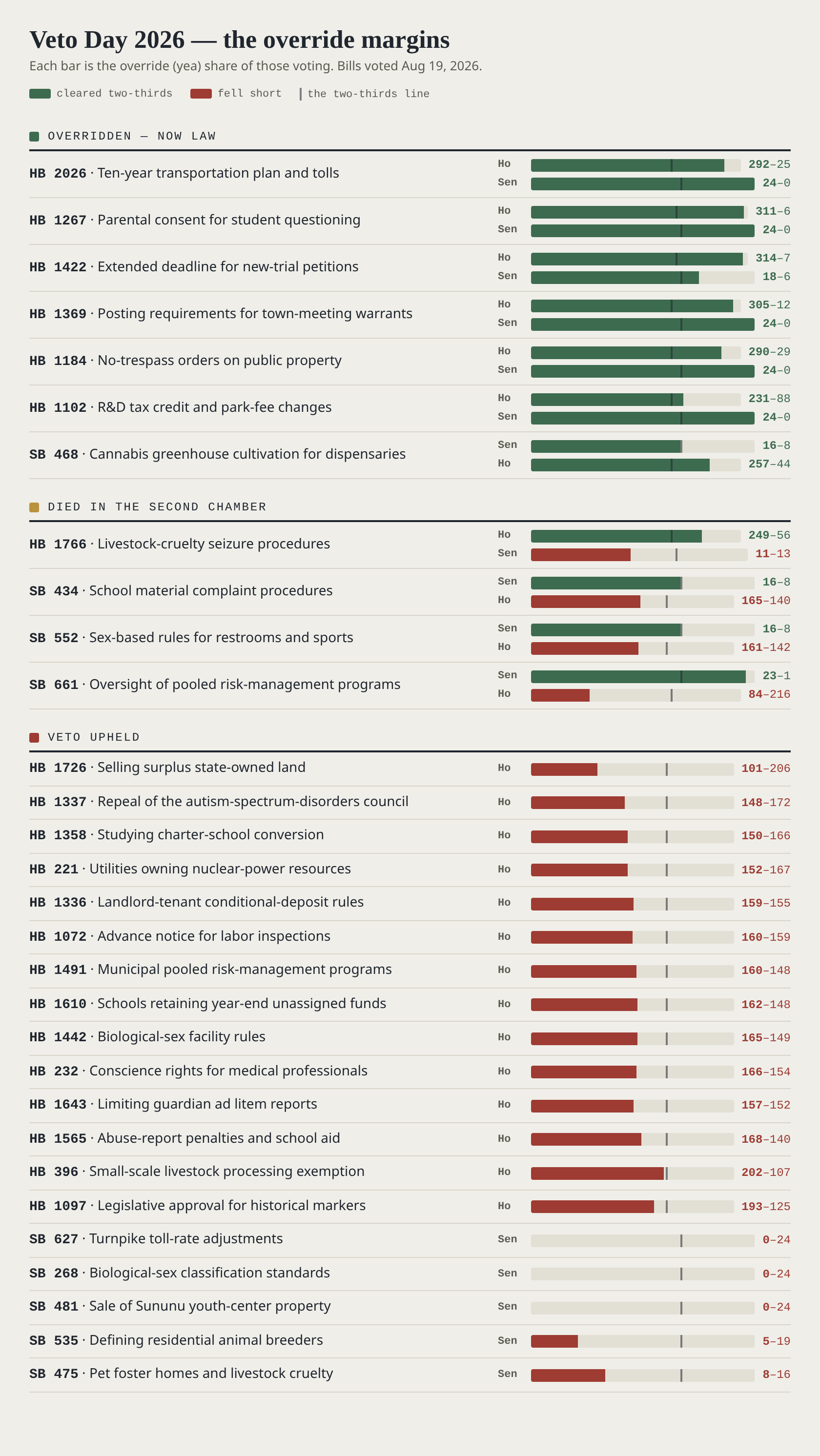
Overridden — now law (7)
Both chambers reached two-thirds. The governor’s veto is struck down and the bill becomes law.
HB 2026 — Ten-year transportation plan and tolls
House 292–25 (overrode) · Senate 24–0 (overrode)
For — Legislators said the plan restores a $400 million shortfall and eleven-plus highway, bridge, and safety projects, protects federal funding, and shifts a minor toll increase onto out-of-state drivers who use but don't pay for New Hampshire roads.
HB 1267 — Parental consent for student questioning
House 311–6 (overrode) · Senate 24–0 (overrode)
For — Requiring written parental permission before law enforcement, attorneys, or outside personnel question a minor student protects both students and parental rights, while keeping an exception for legitimate child-welfare inquiries.
HB 1422 — Extended deadline for new-trial petitions
House 314–7 (overrode) · Senate 18–6 (overrode)
For — New Hampshire's unusual three-year limit can trap demonstrably innocent people whose exonerating evidence surfaces years later, and extending the window to ten only lets a judge weigh credible new evidence without lowering the standard.
Against — Sen. Gannon argued the existing habeas process already frees the wrongfully convicted, that Innocence Project data from large states can't be extrapolated to New Hampshire, and that the change strips finality from victims' families.
HB 1369 — Posting requirements for town-meeting warrants
House 305–12 (overrode) · Senate 24–0 (overrode)
For — With New Hampshire having lost a third of its newspapers, letting towns post special-meeting warrants on their websites instead of costly newspaper ads modernizes notice, saves money, and can widen transparency.
HB 1184 — No-trespass orders on public property
House 290–29 (overrode) · Senate 24–0 (overrode)
For — A statutory process adds basic due process — notice, a hearing, a written decision, and appeal — to a currently arbitrary system that has jailed people like a homeless man held 33 days, while preserving officials' emergency authority.
HB 1102 — R&D tax credit and park-fee changes
House 231–88 (overrode) · Senate 24–0 (overrode)
For — The bill expands the R&D tax credit to draw businesses developing new products and raises state-park fees — unchanged since 2012 — to generate roughly $1.8 million for park maintenance.
SB 468 — Cannabis greenhouse cultivation for dispensaries
Senate 16–8 (overrode) · House 257–44 (overrode)
For — Letting therapeutic-cannabis centers use secure greenhouses with natural sunlight instead of energy-intensive indoor lighting would cut production costs and make the product more affordable for the state's 18,000-plus patients.
Against — Greenhouses are less secure and discreet than the buildings now allowed, could place cultivation near homes and schools and vent odors, and the bill defines no "greenhouse," sets no limits, and guarantees no patient savings.
Died in the second chamber (4)
One chamber voted to override — three of them at exactly the two-thirds minimum — but the other chamber declined, so the veto stands.
HB 1766 — Livestock-cruelty seizure procedures
House 249–56 (overrode) · Senate 11–13 (sustained)
For — The bill adds due-process protections for livestock owners facing seizure — written notice, an independent veterinarian exam, prioritized court review, and return deadlines — and brings veterinary expertise into confiscation decisions.
Against — It would upend a 156-year-old system in which SPCAs have held investigative and animal-housing authority since 1870, imposing impractical burdens on local officials, such as where to house a seized cow.
SB 434 — School material complaint procedures
Senate 16–8 (overrode) · House 165–140 (sustained)
For — The bill requires every district to give parents a process to challenge library books deemed age-inappropriate or obscene, with superintendents and principals — not politicians — making the determination.
Against — Opponents called it a book-banning bill that duplicates existing opt-out law, lets one set of parents dictate what other families' children may read, and infringes students' First Amendment rights.
SB 552 — Sex-based rules for restrooms and sports
Senate 16–8 (overrode) · House 161–142 (sustained)
For — Supporters said the bill protects privacy and dignity by letting public and private entities keep sex-designated spaces limited to those they are marked for, arguing men should not enter women's private spaces.
Against — Opponents said this bathroom bill is nearly identical to versions vetoed before (including SB 148) and still fails to protect the privacy, safety, and rights of all Granite Staters.
SB 661 — Oversight of pooled risk-management programs
Senate 23–1 (overrode) · House 84–216 (sustained)
For — Municipal risk pools give public employees insurance stability and shield communities from surprise bills, helping towns manage costs and hold down property taxes.
Against — Opponents said the bill is worse than its companion and worse than the governor described, and a hoped-for deal to pass both bills had fallen through.
Veto upheld (19)
The first chamber to vote fell short of two-thirds, so the bill died there and never reached the other. Most drew simple majorities — nowhere near the two-thirds an override demands.
HB 1337 — Repeal of the autism-spectrum-disorders council
House 148–172 (sustained)
For — The council only became active after this repeal bill was filed and still hasn't produced minutes, quorum records, or the DMV feedback cited in the veto, so its deadline holds the body accountable while giving it a year to prove itself.
Against — The council is active, nearly cost-free, and valued by the DMV — it created the Blue Envelope Program for safer traffic stops and gives autism families a voice — so repealing it needlessly strips those functions.
HB 1072 — Advance notice for labor inspections
House 160–159 (sustained)
For — Sponsors said they folded in every Department of Labor request over several revisions, that 30-day notice matches standard practice, and that the department keeps full authority to demand any documents it needs.
Against — The Department of Labor should be able to inspect unannounced when appropriate and already gives notice when prudent, so a mandatory 30-day notice is unwarranted.
HB 1610 — Schools retaining year-end unassigned funds
House 162–148 (sustained)
For — The bill lets local voters choose each year to retain up to 3% of the operating budget as a voter-approved emergency reserve, guarding against mid-year cost spikes and sudden property-tax hikes.
Against — It rescinds the indefinite fund-retention authority nearly every district relies on, immediately flushing voter-approved contingency funds — bad for schools, taxpayers, and kids.
HB 1442 — Biological-sex facility rules
House 165–149 (sustained)
For — Supporters said restrooms and locker rooms are designed around biological sex, that women deserve to expect only women in women's spaces, and that the bill merely permits — not mandates — sex-separated facilities.
Against — Opponents called it an unenforceable rollback of transgender non-discrimination protections that would force people to "prove" their sex, endanger anyone whose appearance doesn't match expectations, and protect no one.
HB 232 — Conscience rights for medical professionals
House 166–154 (sustained)
For — Because federal law carries no real penalty, health-care workers — such as a surgical tech assigned to a dilation-and-evacuation — need this bill to avoid being forced to help end a pregnancy or face a hostile workplace.
Against — The bill is unnecessary because federal law already protects medical professionals' right to decline to perform or assist in abortions, and it grants no greater protection.
HB 1643 — Limiting guardian ad litem reports
House 157–152 (sustained)
Against — Opponents said the bill would strip courts of a valuable resource by removing their discretion to have guardians ad litem investigate and recommend in a child's best interest, when the real concerns are better met through training and oversight.
HB 1565 — Abuse-report penalties and school aid
House 168–140 (sustained)
For — The bill creates accountability for people who knowingly file false, malicious abuse reports, while protecting good-faith and anonymous reporting, and lets county nursing homes cover payroll while awaiting delayed federal reimbursement.
Against — Because false-report callers would still stay anonymous, the penalty wouldn't catch bad actors but could deter good-faith callers acting on a gut feeling, so it is safer to err toward child protection.
HB 396 — Small-scale livestock processing exemption
House 202–107 (sustained)
For — Supporters called it good legislation that helps small — not large — farmers sell directly to New Hampshire customers, and said it could be repealed later if it doesn't work.
Against — The other chamber watered down the safety protections the House had built in, making passage worse than passing nothing.
HB 1097 — Legislative approval for historical markers
House 193–125 (sustained)
For — The bill passed committees unanimously (10-0 House, 5-0 Senate) and cleared both chambers on consent, so it should become law.
Against — Bringing historical-marker changes under the legislature contradicts the bill's own goal of depoliticizing the process, and two governors have vetoed it on separation-of-powers grounds.
SB 627 — Turnpike toll-rate adjustments
Senate 0–24 (sustained)
Against — Sen. Waters urged a no vote to sustain the veto, saying the chamber's earlier action on the budget (HB 2) had already resolved the turnpike-funding question.
SB 268 — Biological-sex classification standards
Senate 0–24 (sustained)
Against — Sen. Birdsall said the bill was unnecessary because overriding the veto on the related SB 552 had already accomplished its purpose, so members should sustain the veto.
SB 481 — Sale of Sununu youth-center property
Senate 0–24 (sustained)
Against — Prime sponsor Sen. Rosenwald urged sustaining the veto because the bill would route the youth-center sale proceeds into the general fund rather than the underfunded YDC abuse-settlement fund, making victims compete with other spending.
SB 475 — Pet foster homes and livestock cruelty
Senate 8–16 (sustained)
For — Sen. Birdsall cited a constituent whose two horses were seized without a warrant and who was arrested over an elderly horse he struggled to feed, arguing that livestock-cruelty enforcement abuses need addressing.
Against — Birdsall said he had changed his mind and would sustain the veto because the governor's office committed that morning to work with him on a livestock-cruelty provision for next year's budget.
HB 1726 — Selling surplus state-owned land
House 101–206 (sustained)
HB 1358 — Studying charter-school conversion
House 150–166 (sustained)
HB 221 — Utilities owning nuclear-power resources
House 152–167 (sustained)
HB 1336 — Landlord-tenant conditional-deposit rules
House 159–155 (sustained)
HB 1491 — Municipal pooled risk-management programs
House 160–148 (sustained)
SB 535 — Defining residential animal breeders
Senate 5–19 (sustained)
A note on the numbers
This is a provisional record. The official journal had not yet published the Senate roll calls when this was compiled, so the figures were read from the House and Senate floor-video transcripts and cross-checked against the House roll-call database, where they matched exactly. The one-line arguments are condensed from those same floor debates.
The full record — with a vote-margin chart for every bill — is at news.citizeninarepublic.com.